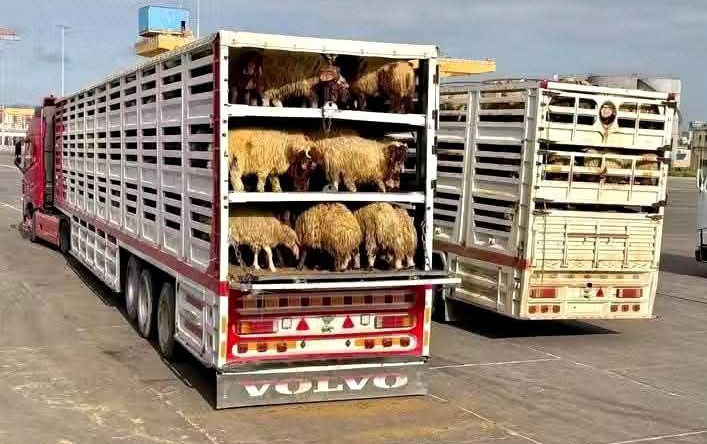
Sheep Exports Shift to Al-Tanf
Syria has begun routing live sheep exports to Gulf markets through Iraq's Al-Tanf border crossing instead of the long-standing Jordanian corridor, following a sharp rise in transit costs through Jordan. The decision was confirmed by the General Authority for Ports and Customs and announced by the Syrian Chamber of Commerce Union on 18 May 2026.
Saudi Arabia is the primary destination. Syria exported about 200,000 head of sheep and goats last year, with lambs currently selling for more than seven US dollars (USD) a kilogram, or roughly 350 to 425 dollars per animal, prices expected to climb further ahead of Eid al-Adha.
Disputed Border Charges
Syrian exporters say transit through Jordan now costs as much as 60 dollars per head of sheep, a level they argue made Gulf shipments unviable for some breeders. Ahmad Shudifat, head of the agriculture and water committee in the Jordanian parliament, rejected that figure, saying actual official charges do not exceed 29 dollars and cover veterinary, quarantine and logistical services.
Footage of Syrian transit trucks turning eastward toward Iraq drew an angry public reaction in Jordan, with calls from political circles for an investigation into possible corruption at the border and into the loss of transit and fuel revenue for the Jordanian economy.
The TIR Corridor
Analyst Melhem al-Jazmati of Karam Shaar Consultancy described Al-Tanf as more than a workaround on fees, calling it a test of Syria's ability to diversify trade corridors. Iraq launched its International Road Transport (TIR) system in April 2025 and made it mandatory for international road freight in November 2025, processing about 2,000 cross-border loads in its first year.
Under TIR rules, sealed shipments cross borders without being unloaded at each checkpoint, cutting time and paperwork. The International Road Transport Union has confirmed that Syria's first TIR loads through Iraq carried live animals to Kuwait and Qatar.
The Real Cost of Distance
The Iraqi route is longer than the Jordanian one, but a wide gap in fuel prices narrows the gap. Iraqi diesel is sold at the official rate of about 400 Iraqi dinars a litre, roughly 0.30 dollars, against around 1.11 dollars a litre in Jordan as of May 2026. For heavy livestock trucks, that differential alone can offset hundreds of kilometres in extra distance.
Analysts caution that the final cost equation depends on transit time, road conditions, waiting at checkpoints and any unofficial payments, variables that remain harder to price.
Leverage for Syrian Exporters
If Al-Tanf settles into a stable, clearly priced corridor under TIR rules, Syrian exporters stand to retain a larger share of their margins on Gulf-bound shipments, while activating regional road haulage and giving Damascus a credible alternative to negotiate with on the southern route. The opening also reconnects Syria to the Iraq-Kuwait and Iraq-Saudi land networks for the first time in years.